Search This Blog

Showing posts with label Sports Car. Show all posts

Saturday, January 8, 2011

2010 Tesla Electric Roadster TAG Heuer Sports Car Concept

With the 2010 Tesla Roadster TAG Heuer, on display at the 2010 Geneva Motor Show, pioneering luxury Swiss watchmaker TAG Heuer and electric carmaker Tesla Motors have teamed up in a worldwide partnership as the iconic Swiss brand celebrates its 150th anniversary.
2010 Tesla Electric Roadster TAG Heuer
This one-of-a-kind collector's car includes a unique interior by Tesla Chief Designer Franz von Holzhausen, incorporating TAG Heuer avant-garde design elements and a specially designed center console due to host TAG Heuer's cutting edge concept watch.
2010 Tesla Electric Roadster TAG Heuer
This car also features a TAG Heuer Meridiist mobile phone as well as a one-fifth second Heuer Limited Edition Stopwatch. This Swiss-made timepiece with mechanical movement pays tribute to the 1860 founding of the company and evoques the mythic revival of the brand's vintage stopwatches.
2010 Tesla Electric Roadster TAG Heuer
The car's exterior color scheme is Foucault Field Gray, embodying the innovative spirit of both companies. The design was inspired by the new TAG Heuer concept watch, a technical milestone in mechanical movements, which brings technologically advanced art to life through motion.
2010 Tesla Electric Roadster TAG Heuer
Since its founding in an artisan's workshop in the Swiss Jura, TAG Heuer has become one of the world's best-known luxury brands - maker of avant-garde watches, eyewear and premium mobile phones for refined consumers around the globe.
2010 Tesla Electric Roadster TAG Heuer
TAG Heuer, a star brand from the luxury group and worldwide leader Louis Vuitton Moet Hennessy (LVMH), also has deep roots in the automotive sector. Company founder Edouard Heuer received in 1911 the patent for The Time of Trip, the first car dashboard chronograph, followed in 1933 by the Autavia - the first dashboard timekeeper for both automobiles and aviation. The benchmark in cutting-edge chronographs and timekeeping technology since 1860, TAG Heuer is the watch brand that can claim the longest and strongest association with motor sports and dream cars. Both watches and chronographs are inspired and driven by motor sports, from Formula One to GT cars.
2010 Tesla Electric Roadster TAG Heuer
"TAG Heuer has a rich history and expertise with the world's most prestigious racing teams - but this is the first ever partnership we've forged with an electric sports car company," said Jean-Christophe Babin, President and CEO of TAG Heuer. "We believe that high-performance drivers are increasingly searching for products that are efficient, socially responsible and stylish. TAG Heuer and Tesla are two of the few companies arleady achieving these ideals today."
2010 Tesla Electric Roadster TAG Heuer
Tesla Motors began developing an electric sports car in 2004 and remains the only automaker selling highway-capable electric cars. The Tesla Roadster accelerates faster than nearly any other supercar yet is twice as energy efficient as a Toyota Prius - the only car that delivers supercar performance guilt-free, with zero tailpipe emissions and a carbon footprint dramatically lower than any comparable sports car.
2010 Tesla Electric Roadster TAG Heuer
Based in California's Silicon Valley, Tesla has delivered more than 1,000 cars to consumers in 21 countries. Advertising Age magazine recently named Tesla one of America's "hottest brands." The Tesla Roadster is quickly becoming the must-have car among Hollywood celebrities, European royalty and socially responsible trendsetters worldwide.

2010 AF-10 Arash Sports Car

Arash Motor Company was born out of a passion for cars, the allure of beauty and the thrill of driving the seemingly end less acceleration of a thoroughbred engine. The engine, or better still, the soul of the AF10 is designed to withstand the punishment of motor racing and we’re sure it will excite even the most accomplished of drivers.
2010 AF-10 Arash
The superlative handling of a chassis designed by leaders in their field combined with extraordinarily forceful braking performance will make you question whether the tyres will still be intact when you climb out. The AF10 seduces and excites on every level with it’s distinctive silhouette and exceptional performance.
Design of the Arash AF10 began in 2005 with styling sketches and renderings. Gradually the design evolved into computer models and aerodynamic CFD mesh models. Finally the finished car was revealed in October 2008.
Powering the Arash AF10 is a GM sourced, mid-mounted, 7.0 litre, V8 which produces 550 bhp @ 6,000 rpm. This is connected to a Grazianno 6-speed manual transmission driving the rear wheels. This drivetrain allows the AF10 to reach 60 mph in 3.4 seconds, and go on to a 204 mph top speed.
The Arash AF10 features a full carbon and steel frame chassis with steel front and rear crash structures and cradles. Covering the chassis is an all carbon fiber body with honeycomb and nomex sandwiches to achieve weight reductions and add rigidity.
The aerodynamic body of the Arash AF10 includes unusual features like the radical front wing which is separated from the main body, and prominent air intake side pods. These features have been influences by Le Mans and F1 race cars, however they also perform specific functions for the overall performance of the car. Split radiators have been used at the front and Oil radiators are positioned in the side pods.
The modular carbon chassis of the Arash AF10 is super light and super strong. This structure is made up of 13 parts assembled into a jig and bonded at temperature.
An estimated 25 Arash AF10 cars will be manufactured per year with a small number being delivered to the US market.
About Arash Cars:
Arash Cars was established in March 2006 and has been working on the AF10 ever since. The styling drawings were made in March 2005 by Arash Farboud Designs and have since been converted into computer models and aerodynamic cfd mesh models.
The company is located in Sawston on the outskirts of Cambridge. Most testing will be conducted at Millbrooke proving grounds 20 miles away from the company. The facility in Sawston Cambridge is equipped with a styling studio, painting booth, carbon lamination room, parts despatch area, carbon curing autoclave oven and polished epoxy floored car assembly stations. A board room and administration offices are also located at the site.
Arash Cars have designed a traditionally shaped badge with an eagle emblem. The background colour is solid black and the foreground eagle is in gold. The 'Arash' emblem is in flame orange.

2010 Novitec Rosso Sports Cars 599 RACE 848

NOVITEC ROSSO RACE 848 – this name stands for an absolutely unique high-performance sports car. Only three of these automotive masterpieces will be built. The two-seater car is based on the Ferrari 599 GTB Fiorano and celebrates its world debut at the Geneva Motor Show 2010.
2010 Novitec Rosso Sports Cars 599 RACE 848
Underneath the striking aluminum skin that sports the unusual color combination of matte white and grey beats an extremely powerful heart: The 2010 NOVITEC ROSSO RACE 848 twelve-cylinder twin compressor engine produces 848 hp / 624 kW of power and has a peak torque of 842 Nm.
Powered by this engine the car sprints from rest to 100 km/h in less than 3.4 seconds, to 300 km/h in just 23.7 seconds, and reaches a top speed in excess of 345 km/h. This exclusive special model also features an aerodynamic-enhancement kit developed in the wind tunnel, three-piece 21-inch wheels with matching sports suspension, a high-performance brake system and exclusive interior options.
The NOVITEC ROSSO RACE 848 is powered by an evolutionary stage of the tried and proven twin-compressor engine conversion for the six-liter V12 four-valve engine of the F599. For an additional power increase of 40 hp / 29.4 kW both mechanical chargers were fitted with modified turbine blades, several details of the engine peripherals were modified and the engine electronics were reprogrammed.
The high-performance chargers have an electronically limited boost pressure of 0.48 bars. The chargers are driven by a cogged belt and have their own dedicated oil circuit. A large water-to-air intercooler with dedicated water circuit also contributes greatly to the optimal power yield. A custom-developed intake manifold, high-performance injectors and sport air filter round out the engine conversion.
In addition, high-performance headers custom-designed for the compressor engine and the NOVITEC ROSSO stainless-steel quad sport exhaust system with a pipe diameter of 90 millimeters are also installed. The intensity of the exhaust note can be adjusted with a little switch on the steering wheel called the ‘manettino.'
The NOVITEC ROSSO RACE 848 specification represents a power increase over the production engine of 228 hp / 167.8 kW to 848 hp / 624 kW at 7,900 rpm. Simultaneously peak torque grows by 234 Nm to 842 Nm at 6,300 rpm.
Longer carbon-fiber NOVITEC ROSSO shift paddles make shifts of the six-speed F1-Superfast transmission even quicker and more precise. The gearbox also plays a major part in the superior performance of the car. Acceleration from rest to 100 km/h takes just 3.4 seconds, the sprint to 200 km/h a mere 9.6 seconds. With a sprint time for 0 - 300 km/h of just 23.7 seconds the NOVITEC ROSSO RACE 848 solidifies its position among the world's fastest-sprinting sports cars. The car reaches a top speed of more than 345 km/h.
This level of performance places highest demands on well-balanced aerodynamic properties which received their finishing touches in the wind tunnel. The NOVITEC ROSSO front spoiler lip reduces lift on the front axle. The rear apron is upgraded visually and aerodynamically with a rear diffuser. The NOVITEC ROSSO rear wing further increases downforce.
The high-performance equipment also includes three-piece NOVITEC ROSSO NF3 wheels shod with Pirelli P Zero high-performance tires. The alloy wheels with five double spokes measure one inch diameter more than the production wheels. The front axle features size 9Jx20 wheels with size 275/30 ZR 20 tires. Size 12.5Jx21 wheels and size 355/25 ZR 21 tires on the rear axle provide excellent traction.
The height-adjustable NOVITEC ROSSO sport suspension also allows the damping rates to be set to the individual preferences of the future owners of the super sports car. The suspension's lift function on the front axle can be activated with a push of a button in the cockpit. It raises the front of the vehicle by 40 millimeters to safely navigate such obstacles as speed bumps or parking garage ramps. Upon reaching a speed of 80 km/h the suspension automatically reverts to its original drive position.

Friday, January 7, 2011

2020 Minotauro Lamborghini Sports Car Concept

Concept cars never cease to fascinate car enthusiasts. If you claim to be a Lambo fan than this latest sports car concept creation is definitely for you. Andrei Avarvarii, a student at Milan's Scuola Politecnica di Design, with assistance from Lamborghini’s design head Filippo Perini, designed this amazing electric 2020 Lamborghini Minotauro concept.
2020 Lamborghini Minotauro concept
The duo worked to achieve three different goals:
1. Aesthetic goal – Explore soft shapes for a new Lamborghini design language,
2. Technical goal – Redefine the Lamborghini supercar as an electric vehicle and
3. Functional goal: Integrate the new vehicle in the reality of the year 2020.
Designed tasty electric sports car concept Lamborghini, uses four electric motors and power sharing 30% / 70% front to rear. 2020 Lamborghini Concept Minotauro designed by a student getting a master’s degree in Milan Scuola Politecnica in Design, Andrei Avarvarii with the help of Filippo Perini head of Lamborghini Design. Li-Tec A flat-cell batteries in the rear and front of the KERS system will provide power.
A breathtaking beauty on wheels imagined for the year 2020, it mesmerizes you with both its looks and features. The concept creation would utilize four electric motors and split the power 30%/70% front to rear while a Li-Tec flat-cell battery out back and a KERS system in the front provide the power.
The Minotauro has two asynchronous 75-horsepower (56-kW, 76-PS) electric motors at the front that provide 30% of the car’s power, and two 175-horsepower (131-kW, 177-PS) electric motors at the rear. The system runs on a Cerio Li-Tec Flatcell battery, with a Kinetic Energy Recovery System also in place.
The press release goes on to explain the bonus of no big V12 out back: The absence of a big V12 engine in the rear creates enough room for a third passenger in a central position, like the legendary Mclaren F1. While the driver’s door would be normal, the passenger side’s would be bigger to provide access to the back seat.
What is more, the absence of the powerful V-12 engine in this concept creation makes room for a third passenger. Keeping this in mind, the passenger’s door would be bigger in order to provide access to the back seat.
But what are sure to appeal to every Lambo fan are the concept’s triangular intakes/exhausts that are not just visually pleasing but serve for battery cooling and act like the tubes of a subwoofer, channeling the sound of the electric motors, placed behind them.
A hi-tech creation, the owners would also be able to upload their own track ghosts to an online community. And if a real racetrack has been / is being covered, the GPS would record car placement / track time, allowing people worldwide to challenge an owner's record.
Guess when it comes to concepts, sky is the limit for the designers.

Thursday, January 6, 2011

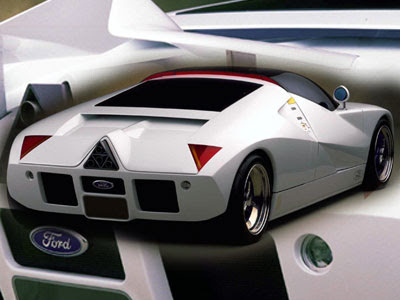
2010 Ford GT90 Super Sport Car Concept going to auction

2010 Ford GT90 Super Sport Car Concept

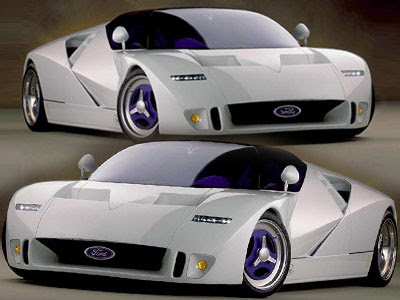
If Ford first introduced the GT90 Concept at the 2010 Detroit Auto Show next month, it would still be one of the most eyecatching cars on the show floor. What's amazing is that Ford unveiled the GT40 successor nearly 15 years ago. What's more, even by today's standards it's still a supercar among supercars.
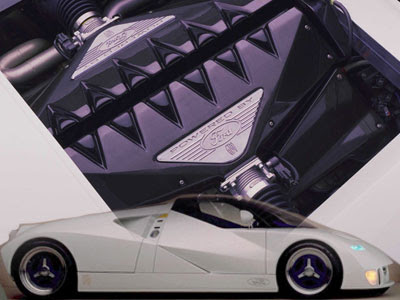
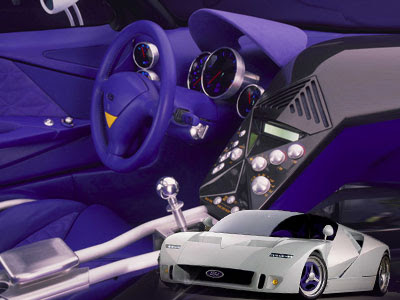
The quad-turbocharged 6.0-litre V12 puts out an estimated 720 horsepower, the body is constructed completely of carbon fiber and top speed is somewhere in the 400 kph range. The only hints that it's not a modern supercar are the all-blue interior and wheels that look dated now.
So what's all the fuss about the GT90 Concept now? RM Auctions in the States has just announced that it will be offering the concept car at its upcoming Arizona sale. That's right, this is your chance to own one of the coolest concept vehicles of all time. This is the first time that the GT90 Concept has ever been publicly for sale at auction, and RM claims that it is in "excellent running condition, having been properly stored and maintained over the year." No estimated on price is given, but we're guessing it will take a large suitcase of cash to take the car home.

2010 Ford GT90 Super Sport Car Concept

The one-off GT90 Concept Car, labeled immediately as "the world's mightiest supercar" by Ford Motor Company on December 6, 1994, was the spiritual successor to the Ford GT40, the product of a colossal feud in the early 1960s between the Blue Oval from Dearborn and the Prancing Horse of Northern Italy. The GT90 draws from the design cues of its heritage and pays homage to the famed Le Mans-winning Ford GT40s of the 1960s, which were created after the failed attempt by Ford to buy out Ferrari.
At a development cost in the neighborhood of $3 million, the GT90 was certainly worthy of pulling styling cues from the original Ford GTs, and although it was never meant for production, it was built according to a Ford press release as a "test bed for technology, engineering and design concepts, and driver-oriented features that eventually may be used in Ford production vehicles."
Officially unveiled to the public in January 1995 at the Detroit Auto Show, the GT90 is finished in bright white with a bright blue and carbon fiber interior. It features a mid engine quad-turbocharged V12 that produces an estimated 720 horsepower and 660 pound-feet of torque. As a result, it had a claimed top speed of 253 mph, which even by today's standards would make it one of the fastest production cars in the world – faster even than a McLaren F1, which was widely considered the world's preeminent supercar at the time.

2010 Ford GT90 Super Sport Car Concept

The engine, which was a 48-valve six-liter V12, had to be combined together with four Garrett Systems T2 turbochargers in order to reach its estimated 720 horsepower and was based on the Ford Modular engine. Created by using parts of two Lincoln V8 engines, engineers removed the last pair of cylinders from the rear of one engine and the first pair of cylinders from the front of the other engine. The cut-down engines were then welded together with the final result being a 90-degree V12, which utilized a 90.2 mm bore and a 77.3 mm stroke to achieve maximum power.
The GT90 features the FFD-Ricardo five-speed manual gearbox found on the XJ220 and, considering the torque load that it is designed to handle, is noted as having a relatively light shift quality. Also borrowed from the XJ220 comes the all around double wishbone suspension that was designed to enable the car to handle well at top speeds.

2010 Ford GT90 Super Sport Car Concept

Using Ford's new "Edge" design philosophy, the car incorporated advanced technology with a mixture of flat planes, angles, glass and triangular shapes that seemingly all collided together. The GT90 was the first car created using this new styling directive from Ford, which went on to be responsible for the creation of other Ford products like the Ka and Cougar. The effect is most impressive and a wonderfully executed stylistic throwback to its GT40 predecessor, which at once stays true to its heritage but acknowledges the advances in modern design. Taken directly from race car technology, the GT90 body panels are molded out of carbon fiber while the chassis is formed out of a honey-comb sectioned aluminum monocoque.
The GT90 is a test bed of advanced technology and design. It sports a tinted, laminated glass bubble over the cockpit and a spoiler that rises off the rear deck at high speeds. According to Ford, it has a "design that tightly enclosed its mechanicals with no wasted space; high tech lighting and blind-spot detection systems; and tiles like those on the space shuttle to shield the V12's exhaust outlets."

2010 Ford GT90 Super Sport Car Concept

After its unveiling in Detroit, the GT90 made its rounds on the Auto Show Circuit in 1995, traveling around the world to Frankfurt and as far away as Tokyo. With few other showings in between, the car recently was shipped over to Europe to be on display in the Ford of Europe 2008 exhibit at the Goodwood Festival of Speed. After returning home, the car was shipped to Alabama where it was on display as part of the Mustang 45th Anniversary Celebration.
This superb concept car remains in excellent running condition, having been properly stored and maintained over the years in between its show appearances. RM Auctions is proud to publicly offer the GT90 for the first time ever at auction. A remarkable one-off piece of automotive history and cutting-edge design, its offering may very well be a once in a lifetime opportunity for Ford devotees and concept car enthusiasts.

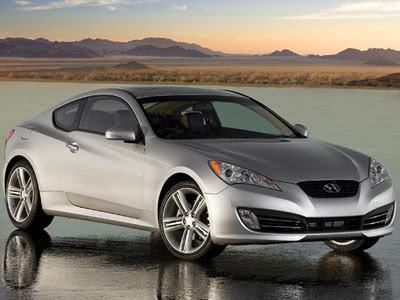
2010 Hyundai Genesis Sports Car Coupe with SHIFTRONIC to handle the additional torque

2010 Hyundai Genesis Sports Car Coupe with SHIFTRONIC to handle the additional torque

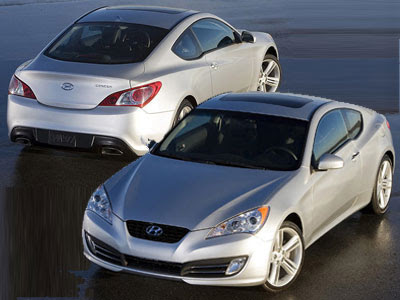
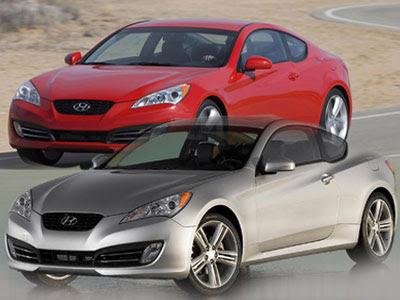
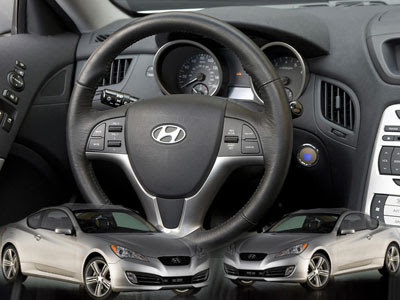
2010 Hyundai Genesis Sports Car Coupe

The people at South Korean automaker Hyundai are listening to their customers. The 2010 Hyundai Genesis Coupe, confirmed for production and a release early in 2009, follows the tradition of the 2009 Hyundai Genesis in offering a true high performance rear wheel drive, sporty architecture in an affordable package. The 2010 Genesis Coupe is a purpose-built rear-wheel drive sports coupe featuring two performance-focused engines - a212-horsepower 2.0-liter turbocharged four-cylinder engine and a range-topping all-aluminum 306-horsepower, DOHC 3.8-liter V6 engine.

2010 Hyundai Genesis Sports Car Coupe

Genesis Coupe employs a MacPherson strut dual-link front suspension and a five-link rear suspension setup. Both engines are mated to a standard six-speed manual transmission. The Genesis Coupe 2.0t (2.0-liter 4-cylinder turbo) offers an optional five-speed automatic with SHIFTRONIC® while the 3.8-liter V6 offers a ZF six-speed automatic transmission with SHIFTRONIC to handle the additional torque.
The Genesis Coupe follows the styling tradition set forth by the Hyundai Tiburon, but outdoes that aging Hyundai compact sports car in every way. The Genesis Coupe comes with an available naturally aspirated V6, sure to be a motor to find its way into more of Hyundai's lineup. The high output engine offers 310 horses on premium fuel. Following the introduction earlier this year of the rear-wheel drive Genesis sport sedan, Hyundai Genesis Coupe is Hyundai's most dynamic performance car ever and the second consecutive all-new model introduction from Hyundai appealing directly to the car enthusiast.

2010 Hyundai Genesis Sports Car Coupe

Hyundai Genesis Coupe uses the same flexible rear-wheel drive architecture originally developed for the Genesis sport sedan.
The 2010 Hyundai Genesis Coupe offers Xenon high-intensity discharge (HID) headlights. The advantages of HID headlamps include greater lighting power, daylight-type lighting and reduced power consumption. In addition, the cut lines of the new HID headlights are extremely precise, providing maximum nighttime visibility without distracting other drivers.
All Hyundai Genesis Coupe models feature standard four-channel ABS with Electronic Brake-force Distribution (EBD) to optimize brake performance under various dynamic loading conditions. The system also includes Brake Assist, which provides maximum ABS-level braking force when a panic stop is detected.

2010 Hyundai Genesis Sports Car Coupe

It is nice to see that Hyundai, an automaker currently enjoying growth and a solid reputation for producing mainstream-market cars that last, is making steps toward the sports car market. The styling of the Genesis Coupe is hit or miss, some will love it and others will wonder what Hyundai was thinking. But, with the sports car pedigree to back it up, the Genesis Coupe should be another worldwide hit for Hyundai.

2010 Hyundai Genesis Sports Car Coupe

The Hyundai Genesis Coupe is offered in three trim levels: the stylish and affordable GS, the premium-sport GT featuring the 3.8-liter V6, and the high-performance SE, available with either the 2.0-liter turbocharged four-cylinder engine or the 3.8-liter V6 engine.

Design Ferrari Sports Cars 458 Italia

PRESS RELEASE Following international acclaim for their finely honed Porsche GT2, GT3 and Panamera conversions, Oakley Design is now proud to announce their tuning programme for the Ferrari 458 Italia. Production will be limited to just 5 cars, each bearing a unique build number plaque. Outside of this Limited Edition model, individual parts will also be made available for clients who do not require the complete package. With Jon Oakley’s motorsport background central to the company’s philosophy, any change, whether aerodynamic or mechanical, is only done for sound technical reasons.
2010 Ferrari Sports Cars 458 Italia
2010 Ferrari Sports Cars 458 Italia Tuning by Oakley Design production will be limited to just 5 cars, each bearing a unique build number plaque. Outside of this Limited Edition mode, individual parts will also be made available for clients who do not require the complete package.
With Jon Oakley motorsport background central to the company philosophy, any change whether aerodynamics or mechanical is only done for sound technical reasons.
Known for its customization programme for the Porsche 997 GT2, Oakley Design revealed today its tuning kit for the latest Ferrari 458 Italia. Because the car is quite perfect the tuning company decided to install a carbon-fiber front spoiler which adds 45kg of downforce over the front axle at 150mph (240km/h) but also a racecar style centrally positioned radiator vent designed to channel air out over the bonnet instead of under the car. And this is not all, as the tuning company installed new air exit ducts beside the headlamps.
Finally, a new rear spoiler with Gurney flap adds 25 kg of downforce over the rear axle at 150mph. This works together with the underbody diffuser to reduce the Italia overall drag by smoothing out the separating airflow. The only exterior alterations made for cosmetic reasons are the signature Oakley Design carbon fibre roof panel, mirror covers and engine cover insert below the rear window glass. These are matched in the engine bay by carbon-fibre panels covering the inner wings and rear bulkhead.
In order to optimize the sound of the engine, the car features a complete titanium exhaust system with triple outlet pipes and no bypass valve shaves a huge 30kg from the Italia’s aft section.
The design is completed by the 20-inch Oakley Design lightweight composite wheels which save a significant 8.0kg of unsprung weight per corner. For those who don’t know the standard 458 Italia comes with 570bhp and 540 Nm of torque but with some ECU tweaking the car delivers now 627bhp and 567 Nm of torque. With these numbers, the car ca sprint from 0 to 100 km/h in just 3.0 seconds (standard version can sprin in 3.4 seconds) and has a top speed of over 330 km/h. We have bad news though: the production of this customization programme will be limited to just 5 cars, each bearing a unique build number plaque.
Related Posts Plugin for WordPress, Blogger...