Here's the INDIAN FLAG CAR. The Indian Formula One Racing team Force India, while yet to get of the bottom of the pile, came close to winning their first F1 points in Shanghai last week. The team sports the Indian flag as its team colors and has attracted sponsorship from Indian companies Kingfisher, ICICI Bank, Reliance Industries and Kanyan Capital. Force India was formed after Indian businessmen Vijay Mallya and Michiel Mol bought the Spyker F1 team for US$115 million. The team races its own designed cars, powered by Mercedes-Benz, and was able to rise from 18th to as high as sixth with just 5 laps to go.
With Delhi being added to the Grand Prix circuit in 2011, Force India are learning and may well be a team to reckon with by the time the Delhi Grand Prix arrives. The team has just signed a five year agreement with Mercedes for engines, and a partisan Indian crowd in Delhi may make a large impact at the event.
The participation in, and rise to prominence of an Indian team in F1 is in marked contrast to China, which despite having hosted the F1 in Shanghai for the past few years, does not field a competing team. This is somewhat surprising, given that both China and India are poised to be the world’s largest auto markets in the next two to three years, with more vehicles having been sold last year in China than in the United States for the first time.The Chinese logic for hosting the event, but not participating, seems a little skewed. The Chinese government pays Formula One about US$50million each year to host the Shanghai event, yet the country has not followed that up with a competing presence, cars or drivers, in the rest of the series. The prices to attend the Shanghai event also seem bizarre if China wants to use it to promote its auto industry.
Shanghai wages averaging at about US$500 a month, that’s equivalent to the price of the cheapest ticket on offer for the Shanghai F1. You would need to charge US$4,000 to attend the Indianapolis 500 in the United States to achieve a similar disparity. So while Force India prepares the world for Indian cars and trucks Tata having already acquired global brands Jaguar and Land Rover, and about to launch Tata as a brand name in Europe and the United States through the Nano and its trucking division – the Chinese are just not getting on board. It’s a curious state of affairs, especially since F1 have apparently re-signed with Shanghai to host the event for another seven years. US$50 million seems a lot to pay for a one off annual event that the local Chinese cannot generally afford to attend, in which no Chinese team participates, in a 17 race series which is broadcast globally and attracts hundreds of millions of viewers.
Force India meanwhile are pushing forward at the top end the concept of Indian vehicles as reliable, and developing India as a manufacturing brand in auto that will assist its national auto manufacturers integrate into and penetrate international markets.
Showing posts with label RALLY. Show all posts
Sunday, August 1, 2010
Indian Flag Car
Labels:
auto,
Car Prices,
engine,
flag car,
Land Rover,
racing,
RALLY,
Series,
special,
Vechicles
Wednesday, July 21, 2010
McLaren F1 (1993)

Labels:
auto,
engine,
Mclaren Cars,
RALLY,
speed,
turbocharger
Honda HSV-010 GT

Engine name: HR10EG
Configuration: Liquid-cooled, naturally aspirated, longitudinal V8, V angle: 90°, Valve train: Gear-driven DOHC - 2 intake and 2 exhaust valves per cylinder, Displacement: 3397 cm3, Bore x stroke: 93.0 x 62.5 mm, Maximum output: 500 PS (370 KW), Maximum torque: 392 Nm,Throttle control system: Mechanical, Fuel supply system: Programmed fuel injection system (Honda PGM-FI), Fuel: Lead-free premium gasoline, Lubrication: Dry sump.
Audi to Show Seven Customized A1 Models at Worthersee
This year's edition of the Worthersee GTI Tour that takes place in Reifnitz, Austria, on May 12 will see Audi showcasing seven custom versions of its new A1 premium supermini, including a model sporting an "FC Bayern" look, taxi and police variants. The other four custom A1s are a "Hot Rod" version with a matt-finish look, steel wheels with white-wall tires and extremely low ride height thanks to the air suspension, one fitted with a "competition kit" that pays homage to Audi rally vehicles from the 1980s, the "Wasserwacht" model that's dedicated to the local water rescue service and a "Fashion" edition. "The Audi A1 fits in with the GTI meet because customization has always been a central topic for the Audi fans here at the Worthersee and will also play a special role for A1 customers," says the Head of Audi Design, Stefan Sielaff, who was responsible for the creation of the special edition models. The seven special A1s will be joined at Audi's Worthersee stand by an array of models including the new Audi R8 GT, an Ice Silver A8, the facelifted TT Roadster and the TT Coupe and the new RS5 Coupe.
Monday, July 5, 2010
Devon GTX


Sunday, July 4, 2010
Citroen DS3 R3

Tuesday, June 29, 2010
ABT VW New Beetle Cabriolet


The ABT VW New Beetle Cabriolet including two types of back-silencers, an aluminium gear lever knob, aluminium pedals, stainless steel running boards, as well as a set of floormats displaying the Abt Sportsline logo. Additionally, a New Beetle owner can choose between 14 wheels, one of them being the brand-new Z5 wheel (8 x 18") presented on the IAA motor show.The 2.0-litre engine receives a power plus to ca. 105 kW (143 hp) thanks to capacity enhancement by 200 cubic centimetres, a customized Abt crankshaft, special pistons, Abt camschafts, a cylinder head modification, a mid-silencer, optimised air ducting as well as changes to the electronic engine management. Abt expertise in the ECU field ensures an increase in the 1.8-litre turbo-engine from 110 kW (150 hp) to 142 kW (193 hp). For the 1.9-litre TDI, Abt provides an increase from 66 kW (90 hp) to 85 kW (112 hp).A front grill, chrome fog headlamp frame, headlamp visor and the matching V-rims (7.5 x 17 inch) rounds off the New Beetle body kit from the House of Abt.A very special example of the New Beetle caused a sensation in German rallying: Together with natural gas supplier Thyssengas, Abt enters a Beetle in the German Rally Challenge series and the German Rally Championship. The highlight: The 230 hp model uses natural gas instead of traditional fuel.
2011 Mercedes SLS AMG GT3

Monday, June 28, 2010
Bugatti Veyron Centenaire

The Bugatti Veyron Centenaire is a very expensive and good looking car in the world .The Type 35 Grand Prix was by far the most successful racing model. The unmistakable radiator grille and eight-spoke aluminium wheels of the Type 35 have become defining features of the Bugatti automobile. In its day, the Grand Prix was also well ahead of its time in terms of engineering ingenuity.The Grand Prix's brake drums were integrally fitted into its lightweight aluminium wheels. Unfastening the central wheel nut allowed the wheel to be easily removed within a matter of seconds and the brake to be exposed. This was a crucial advantage at the pit stop.Supposedly called the Centenaire edition, reports suggest the special Veyron an increased power rating – word on the street has always been that the Veyron's quad-turbo W16 was always capable of more than the already astronomic 1000 horsepower rating it got – up to some 1350 horses, good enough to boost the top end up to 420 km/h (261 miles-per-hour) from the current benchmark of 400 km/h (253 mph). Special paint schemes and trim pieces will surely be part of the mix as well, but hitting the Willard Scott mark may prove enough to warrant a more substantial birthday gift if the rumors are to be believed.
Labels:
auto,
Bugatti Veyron,
Car Drifting,
edition,
engine,
model,
racing,
RALLY,
vantage
Bugatti Galibier


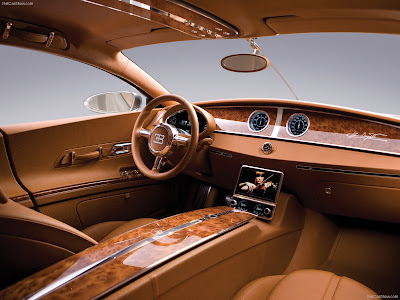
The Bugatti Galibier's design masters the challenge of uniting sportiness with the comfort and elegance of a modern four-door saloon. The basic architecture picks up on the torpedo-like character of the Type 35, which was already revived in the Bugatti Veyron, and reinterprets it.The Bugatti Galibier i16-cylinder,8-litre engine with twostage supercharging and features 64 valves, generating 1001 horsepower at 6000 rpm.The Bugatti Galibier engine special is that it was developed as a flex-fuel engine and can optional be run on ethanol. Four-wheel drive, specially developed ceramic brakes and a new suspension design enable the agile, always-sure handling of a saloon of this size. The engine draws on its 8-litre displacement to deliver a maximum torque of 1250 Newton-metres between 2200 and 5500 rpm. Apply the brakes at speeds above 200 km/h, and the rear wing acts as an airbrake, positioning itself at an angle of 113 degrees in less than 0.4 seconds, augmenting the Bugatti Veyron's already impressive stopping power. The airbrake increases negative lift at the rear of the car to 300 kg, enhancing the braking torque on the rear axle. At 400 km/h, emergency braking will bring the sports car to a complete halt in less than 10 seconds.This striking and unparalleled harmony between luxury and sportiness is complemented by alloy-coloured details in the form of the chromed Bugatti grill and door-mirrors, as well as polished wheel surfaces and roof-rails. All-black front lights, air intakes, filler caps and door-handles naturally heighten the stunning effect of the racing-blue brake callipers.
Labels:
Bugatti Veyron,
engine,
luxury cars pics,
racing,
RALLY,
speed,
wheel
Bugatti Veyron Sang Noir


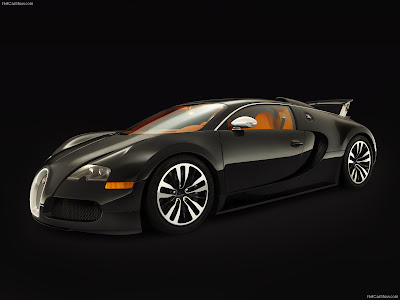
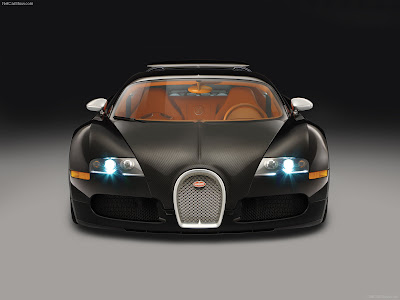
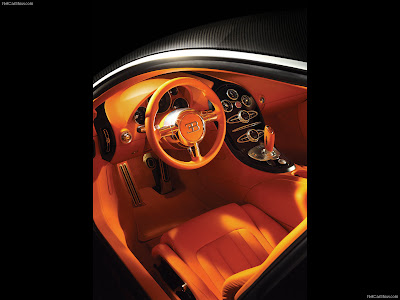
The Bugatti Veyron Sang Noir is a special edition, created for the true automotive connoisseur.Similar to its thoroughbred predecessor, the Type 57S Atlantic, the Bugatti Veyron Sang Noir exposes a raptor-like DNA that is reflected throughout the entire model history of the marque..The Bugatti Veyron Sang Noir is a special edition, created for the true automotive connoisseur.The 16-cylinder "W" configuration engine is fed by four turbochargers and features 64 valves, generating 1001 horsepower at 6000 rpm. The engine draws on its 8-litre displacement to deliver a maximum torque of 1250 Newton-metres between 2200 and 5500 rpm. Apply the brakes at speeds above 200 km/h, and the rear wing acts as an airbrake, positioning itself at an angle of 113 degrees in less than 0.4 seconds, augmenting the Bugatti Veyron's already impressive stopping power. The airbrake increases negative lift at the rear of the car to 300 kg, enhancing the braking torque on the rear axle. At 400 km/h, emergency braking will bring the sports car to a complete halt in less than 10 seconds.This striking and unparalleled harmony between luxury and sportiness is complemented by alloy-coloured details in the form of the chromed Bugatti grill and door-mirrors, as well as polished wheel surfaces and roof-rails. All-black front lights, air intakes, filler caps and door-handles naturally heighten the stunning effect of the racing-blue brake callipers.
Labels:
auto,
Bugatti Veyron,
edition,
engine,
luxury cars pics,
model,
racing,
RALLY,
speed,
turbocharger,
wheel
Tuesday, June 22, 2010
Wartburg Car
Sunday, June 20, 2010
Porsche 911 GT3

The new GT3 is naturally built for superior safety even at very high speeds.The six-speed manual gearbox now provides shorter transmission ratio increments, taking the extended rev-range of the GT3 engine into account. On the road or track, this means acceleration from 0-62 mph (0-100 km/h) in just 4.3 seconds, with the GT3 charging on to 99 mph (160 km/h) in 8.7 seconds. Top speed is 310 km/h or 193 mph.This is aided in particular by the car's low weight of 3076 pounds (1395 kilos), the dedicated tuning of the PASM, the increased performance of the brakes, and the new sport tires. On the track this means even faster lap times, while in everyday motoring this equates to supreme active safety.
IMPROVED AERODYNAMIC BALANCE
Developing a specific output of 115.3 bhp per liter, this power unit ranks at the top of all normally-aspirated engines in cars currently homologated for road use. This performance is the result of a consistent, far-reaching process of ongoing development seeking to increase engine output without increasing the size of the engine itself. Displacing exactly 3.6 liters, the six-cylinder featured in the new Porsche 911 GT3 capitalizes on the displacement limit allowed in its category of motorsport, developing 415 bhp at 7600 rpm and reaching a maximum engine speed of 8400 revs. Peak torque, in turn, is 300 lb-ft at 5500 rpm.
By comparison, the former Porsche 911 GT3 developed maximum output of 381 bhp at 7400 rpm and peak torque of 284 lb-ft at 5000 rpm.
The big advantage of the new system is that intake camshaft adjustment is now up from 45-degrees to 52-degrees, further enhancing the engine's qualities in terms of output, torque and emission management. The intake camshafts have also been revised, with intake valve stroke increased by 0.4 millimeters over the previous model to 12.7mm
Ferrari 430 Scuderia

T he new model is a special series based on the Ferrari 430 Scuderia .The 430 Scuderia is a truly high-performance 2-seater berlinetta which demonstrates how Ferrari's Formula 1 know-how is carried across to its production cars.The Ferrari 430 Scuderia car can count on an extremely low weight-to-power ratio of just 2.45 kg per bhp thanks to a low dry weight of just 2755 lb - 220 lb less than the Ferrari 430 Scuderia - and to the naturally-aspirated 4308cc V8's 510 bhp at 8500 rpm.There is the latest software - F1 Superfast - which reduces gearchange times to just 60 milliseconds, and new traction control which, for the first time, combines the E-Diff electronic differential and the F1-Trac traction and stability control in a single integrated system.
Pininfarina Sintesi


The basic theme of Pininfarina Sintesi is a continuous looped surface that, starting from the front wing, stretches along the side of the car, naturally blends into the rear fender and then turns around the side window to dive back under the front wing. Like a Moebius ring, uniting the inside and outside of the car. The four doors open independently. The aerodynamic under body allow to reach an exc6ellent CX value of 0,272 The rear lights incorporate not only the newest LED Osram technology but also cameras and sensors and visually connects the rear to the side by underlining the central axis. The instrument panel of Pininfarina Sintesi is designed as one integrated semi-transparent piece, deriving its richness from a sophisticated play of light that serves as a visual feedback for the different functions. A kind of network capable of rendering "transparent" the communication systems of individual cars and guaranteeing safe, efficient mobility. The user interface will be highly intuitive, it will use a language - created by Pi Shurlok - made of lights and colors capable of being immediately understood by the driver with no signs or icons in the way. All the information currently provided by the infrastructures (traffic lights, road signals) will be displayed inside the vehicle.Pininfarina Sintesi will communicate with other cars and will be able to select the best route.
Saturday, June 19, 2010
Jaquar XK

In-gear times are equally impressive, with the naturally aspirated XK accelerating from 50-70mph in just 2.5 seconds.
Labels:
Advanced fast cars,
coupe,
engine,
Jaguar,
Jaguar XK Cars,
model,
RALLY,
sebring,
speed
Thursday, July 16, 2009
Acura TL Type S 2007
With the updates for 2007, the style could more accurately be called "Bauhaus with attitude." Careful attention was paid to give the Type-S its own distinctive and even more aggressive look. Black chrome trim used around the car is an excellent example of the difference between the TL and the Type-S. The design features and changes include: Front Aggressive front fascia, a new larger grille opening, larger "A" mark and honeycomb mesh Redesigned bumper with satin chrome crossbar and horizontal trim New headlight clusters with daytime running lights (DRL) on innermost lens New auto-on and auto-off headlights (previously auto-off only) Fog lights repositioned from headlight cluster to lower valance Side New, split 5-spoke alloy wheels in Blade Silver finish New exterior mirrors with integrated turn signal lights Rear New rear bumper design Redesigned LED taillight clusters New italicized TL logo Type-S Exclusive Features Black chrome grille trim (satin chrome on TL) Redesigned bumper with black chrome crossbar and horizontal mesh trim Pronounced "splitter" lip on front valance 10-spoke alloy wheels in Dark Euro Silver Smoked rear side marker lights Wider, more aggressive side sill moldings Exclusive rear bumper with trunk lid spoiler diffuser Redesigned and unique lower valance Large diameter quad exhaust finishers Black chrome taillight trim New Type-S logo Interior The Acura tradition of interior prestige and tailored function continues with an elegant and sporty interior for the TL. The instruments and controls are arranged to create an intimate and functional driver's cockpit that offers a feeling of connection and control. With its higher belt line, the TL has a substantial look and feel. Fine interior materials such as leather trimmed seats and real metal trim combine with close attention to detail and finish to give the TL a tangible feeling of elegance. The large interior has stylish and highly supportive seating and generous front and rear headroom. The long TL standard feature list includes items like the first North American application of a standard Sound System with 6-disc CD, DVD-Audio, DTS(R) and Dolby(R) Pro Logic(R) II audio system that takes advantage of the latest technology to deliver sound resolution that's 500 times higher than conventional CD audio. XM(R) Satellite radio is also on the standard equipment list, as is a new MP3 player jack in the center armrest storage bin. The standard Acura HandsFreeLink(TM) system lets the driver dial a Bluetooth(TM)enabled mobile phone by voice, while a new, higher-resolution Multi-Information Display (MID) shows mobile phone data, tracks the car's maintenance needs, displays warnings and offers an array of driver preference settings. The available Acura Navigation System with Voice Recognition has a large 8-inch display with a new, redesigned interface and AcuraLink(TM) satellite communication system with Real-Time Traffic. All TLs receive many updates to their interiors for the 2007 model year. Instrumentation, leather trim, accent trim and Active Noise Cancellation in the Type-S are all part of the driving experience of the 2007 TL. Additionally, there are distinct styling differences between the TL and Type-S models. In addition to red ambient lighting (instead of the blue on TL models) the Type-S receives carbon fiber trim in place of wood, paddle shifters on automatic-equipped models, more highly bolstered front seats, stainless steel sport pedals, contrast stitching on the door panels, seats and steering wheel, and an available 6-speed manual transmission. Styling The TL interior has a dynamic and distinctive look, yet upholds the longstanding Acura tradition of highly functional driving environments. Given the sharp handling agility and power built into the TL, its interior echoes a clear sporting message. Fine details and rich surface finishes make it clear that the TL has not strayed from its luxury roots. Sweeping aluminum-alloy accents with a new pattern for 2007 wrap around the doors, flow onto the instrument panel and dive down the center console. Wood patterned accents warm the interior in the TL, while Type-S models have carbon fiber-look accents and contrast stitching on the door panels, seats and steering wheel, which creates an edgy look. At night, the TL interior is transformed by new ambient lighting. The TL is bathed in a subtle blue light that coordinates with the instrumentation lighting, switchgear, and accent lighting, including the new footwell lighting. On the Type-S, red lighting replaces the blue, reinforcing its role as the enthusiast model. Driver-Oriented Cockpit The TL interior puts all important systems and controls within easy reach of the driver. The systems used most frequently-audio, cruise control, Acura HandsFreeLink(TM) and Acura Navigation System with Voice Recognition(TM)-have satellite controls positioned on the new 3-spoke steering wheel, leather-wrapped on Type-S. The new instrumentation is backlit and easy to read, and the displays have an uncluttered look and intuitive operation. The Multi-Info Display has been redesigned with higher resolution for better readability. Helpful features make driving easier, like power rearview mirrors that can be set to automatically tilt-down when reverse is engaged to make parking simpler. With a driver's 8-way power seat and a tilt/telescoping steering column, it's easy to get comfortable in the TL. The one-touch moonroof switch is located in the overhead console. The Sequential SportShift selector features an intuitive interface for ease of use. The short-throw, close ratio 6-speed manual gearbox falls naturally to hand, and the shift knob and console-mounted parking brake lever are covered in a new textured leather. There is also a bottom-hinged throttle pedal with a more linear feel and natural motion. The Type-S features sporty-looking stainless steel pedals and a new carbon fiber-look automatic transmission shift knob in addition to the steering wheel-mounted paddle shifters. Safety The 2007 TL and TL Type-S were developed to help protect its occupants with a comprehensive array of safety technologies, high-grade materials and advanced construction techniques. Weight sensors are incorporated in the front passenger seat to determine the total weight on that seat. If it is less than 65 pounds (as if occupied by a small child or car seat) the front airbag will not deploy and a warning message appears on the instrument panel. For the driver, a position sensor in the seat determines how the airbag will be deployed in the event of a frontal collision. If the seat is close to its forwardmost position, the front airbag is designed to deploy in the dual-stage mode. Otherwise, the airbag deploys in either single or dual-stage mode based on the severity of the collision and seat belt use. The TL and TL Type-S also feature adjustable rear outboard head restraints, and standard side curtain airbags. These technologies, and the use of high-tensile steel in critical areas and computer-modeled crush zones, help to ensure a high level of passenger protection. The TL passed the toughest government safety tests with a 5-star frontal rating in addition to achieving a "GOOD" rating in all categories evaluated during the IIHS frontal offset collision. The TL safety equation even extends to pedestrians with structural elements designed to reduce the likelihood of serious injury in a collision. Powertrain Two engines are available for the 2007 TL. Under the hood of the TL is an all-aluminum 3.2-liter V-6 with 24 valves and Acura's VTEC(R) - Variable Valve Timing and Lift Electronic Control system. It delivers 258 horsepower and 233 lb-ft of torque. The TL Type-S is powered by a modified version of the 3.5-liter VTEC V-6 found in the Acura RL. With more displacement than the TL engine and a high-flow exhaust system, it boasts 286 horsepower and 256 lb-ft of torque. Both engines benefit from Acura's groundbreaking VTEC system. This patented technology provides an exceptionally flat torque curve, enhancing high-rpm horsepower without sacrificing low-end torque. The result is an engine with excellent responsiveness at all engine speeds. The standard transmission in the TL and TL Type-S is an all-new electronically controlled 5-speed automatic. Developed from the RL's 5-speed automatic, this transmission has more torque capacity that the one it replaces, but more compact. It also features Acura's Sequential SportShift system. Inspired by Formula One(R) racecars, Sequential SportShift gives the driver the flexibility of a self-shifting automatic or the control of a manual. The system has been reprogrammed this year for smoother operation and enhanced gear holding capabilities. In addition, the TL Type-S "rev matches" during manually selected downshifts. Available on Type-S models is a smooth-shifting 6-speed close-ratio manual transmission. Similar to the manual transmission on the 2006 TL, it features a re-designed bellhousing and improved clutch feel for smoother, more linear engagement. With Acura's unwavering commitment to the environment, both TL engines meet strict CARB LEV-II ULEV standards. In addition, cold-start emissions are improved thanks to the close-coupled catalytic converter system and under-floor catalyst. TL Engine 3.2-liter SOHC V-6 aluminum alloy engine 258 hp at 6200 rpm and 233 lb-ft of torque at 5000 rpm Variable Valve Timing and Lift Electronic Control (VTEC(R)) Dual-stage induction system with lightweight magnesium intake manifold Cold-air intake system Computer-controlled Programmed Fuel Injection (PGM-FI) Direct ignition system Compact in-head exhaust manifolds High flow close-coupled catalytic converters plus under floor catalytic converter High capacity 32-bit RISC processor engine control unit 105,000 mile tune-up intervals TL Type-S Engine 3.5-liter SOHC V-6 aluminum alloy engine 286 hp at 6200 rpm and 256 lb-ft of torque at 5000 rpm Variable Valve Timing and Lift Electronic Control (VTEC(R)) Dual-stage induction system with lightweight magnesium intake manifold Cold-air intake system High flow, sport tuned exhaust system with quad finishers Computer-controlled Programmed Fuel Injection (PGM-FI) Direct ignition system Compact in-head exhaust manifolds High flow close-coupled catalytic converters plus under floor catalytic converter High capacity 32-bit RISC processor engine control unit 105,000 mile tune-up intervals 5-Speed Automatic Transmission All-new compact design w/ high torque capacity More compact design Sequential SportShift re-programmed to allow quicker, more positive downshifts and upshifts (Type-S only) Improved coordination between Drive-by-Wire(TM) throttle system and transmission for smoother shifts Steering wheel-mounted F1(R)-style Sequential SportShift Paddle Shifters (Type-S only) External transmission fluid cooler (Type-S only) Advanced shift-hold control limits up-shifts during spirited driving Advanced Grade Logic Control System reduces gear "hunting" when driving on steep hills Linear solenoid direct-acting control reduces shift shock and improves smoothness Lockup torque converter design for superior fuel economy 6-Speed Manual Transmission (TL Type-S only) Close ratio spacing for maximum performance Multi-cone synchronizers (first through fourth gears) Reverse lock-out feature prevents accidental engagement Lightweight high-pressure-cast aluminum-alloy transmission housing Improved clutch feel for smoother engagement Advanced clutch torsion mechanism reduces gear noise Helical gear limited-slip differential reduces wheel spin and maximizes acceleration Emissions/Fuel Economy Meets CARB LEV-II ULEV standard TL EPA fuel economy 20/29 mpg (city/highway) TL Type-S EPA fuel economy 19/28 mpg (AT) and 20/29 (MT) High flow close-coupled catalytic converters plus under floor catalytic converter High capacity 32-bit RISC processor engine control unit Noise Vibration and Harshness (NVH) Highly rigid aluminum-alloy block with cast-in iron cylinder liners 60-degree V-angle for inherently smooth operation Dual-mass flywheel (6 MT) reduces driveline noise and vibration Automatically tensioned, maintenance-free serpentine accessory drive
Labels:
Acura,
Advanced fast cars,
auto,
Auto show,
luxury cars pics,
Need for speed,
RALLY,
speed,
vantage,
wheel
Wednesday, July 15, 2009
AC Schnitzer Tension Street Version

Naturally the "small brother" could not be a 1 : 1 copy of the Concept Car, as the TENSION is a technology showcase which demonstrates what is technically feasible. In contrast, the TENSION Street Version had to incorporate suitability for everyday use with no loss of driving pleasure or reliability.
The focal point of the development work was adaptation of the breathtaking, costly aerodynamic conversion for series production.
The bonnet of the AC Schnitzer TENSION, restyled from the standard 6-series, is used on the Street Version. It reveals at first glance, from its large air outlet edged in a chrome frame, that the ventilation of the power plant is actively supported by sufficient cooling air flow .
AC Schnitzer ACS5 5Series E61 Touring

The AC Schnitzer program for the 5 series Touring includes - among others - several diesel power upgrades for the models 520d, 525d, 530d and 535d.
With the last mentioned one, the 5-series gets an extra 38 HP (28 kW), which increases the maximum torque of 90 Nm. Despite the increased power of the ACS5 3.5d, the excellent driving performance, moderate fuel consumption and superb durability naturally remain unchanged.
AC Schnitzer ACS4 Z4 Sport Coupe

Now that the Z4 Roadster has undergone a facelift and at the same time the M-variant, the Z4 M Roadster, was launched, the model range has been completed with a new Z4 Coupé and MCoupé. Not only BMW but also we at AC Schnitzer are thrilled with the range of new Z4 vehicles, and present our interpretations: the AC Schnitzer ACS4 Roadster and the AC Schnitzer ACS4 Coupé.
The product range extends from suspension components and exhaust systems, through a wide range of wheel and tyre combinations, to special aerodynamic conversions and last but not least interior accessories.
The aerodynamic range has been designed so that - with few exceptions - the special accessories for the ACS4 Roadster will also fit the ACS4 Coupé, and similarly the conversions for the ACS4 M Roadster are compatible with the ACS4 M Coupé.
To improve the driving dynamics, for the Z4 M Roadster and M Coupé we offer a modified rear axle ratio of 3.91 : 1 (standard 3.62 : 1). The AC Schnitzer rear axle ratio guarantees greatly improved acceleration.
The response behaviour is improved on all Z4 models thanks to the AC Schnitzer sports rear silencers. Made completely of special steel with chromed Racing tailpipe, they also provide a more sonorous note than the standard system. For purely visual enhancement, on the Z4 Roadster and Coupé chromed tailpipe trims are available in the same design.
For the M-versions of the Z4 that are fitted with a twin sports silencer as standard, as well as the Twin Racing system there is a further option of Sports Trim Design. This design is reserved exclusively for M-vehicles and was previously seen on both the M5 and M6.
Faster and more precise gear shifts promote the adrenalin rush and perceptibly improve acceleration in a car. So the AC Schnitzer Short Shift has been adapted for the BMW Z4 3.0i, 3.0si and M-versions with manual transmission.
For safe control at all times of the driving performance of the new BMW Z4 models, except M-variants, a special high performance brake system has been developed for the front. The internally vented and slotted brake discs measure 334 mm in diameter and are 32 mm thick. The special brake calipers are fitted with two 42 mm pistons. Naturally the standard ABS system is retained in full.
Extensive tests on race tracks and public roads have resulted in the development of a complete suspension concept consisting of AC Schnitzer sports suspension, special antiroll bar kit and strut braces. The total concept, the components of which can also be fitted individually, achieves sports handling with the same high standard of driving comfort.
In addition, exclusive to the M Roadster and M Coupé is a special racing suspension which is currently still in the development phase.
The suspension concept for all ACS4 Roadster and Coupé models naturally also includes the AC Schnitzer Type IV, Type III and Type II alloy and racing rims in one-piece and multipiece construction. As well as a wealth of wheel and tyre combinations in 17", 18" and 19", we can now offer the largest wheels for the Z4 Roadster and Coupé in 9.0J x 20" with tyres 245/30 R 20.
The M Roadster and M Coupé are even fitted with 9.0J x 20" and 245/30 R 20 on the front and 10.0J x 20" with 285/25 R 20 on the rear. For tyres, we recommend high performance tyres from Continental and Michelin.
The bodywork of the AC Schnitzer ACS4 models reveals the high technical standards that we apply to our products. So for the Z4 Roadster and Coupé and for the M Roadster and M Coupé there are two tailored outfits that fulfil these attributes.
The front part of the Z4 Roadster and Coupé is enhanced by the strikingly designed front spoiler attached to the standard front skirt. This also ensures better downforce. The rear is rounded off by the new AC Schnitzer rear skirt which not only harmoniously integrates the sports rear silencer into the rear but at the same time gives the vehicle a more imposing appearance.
For both the M Roadster and M Coupé, an aerodynamic package has been created which sets even more sporting accents through its styling language and the use of carbon. The package consists of carbon front spoiler elements that optionally can be joined to the front spoiler with chromed aluminium supports. In addition, the new AC Schnitzer chrome front grille gives the vehicles a trendy retro look and at the same time meets the high air flow demand of the 3.2 litre high revving engine.
The vehicle rear is enhanced with a fully integrated carbon rear diffuser. This diffuser is available with two different versions of the special rear skirt edge frame which, depending on which exhaust is fitted, give the "Finishing Touch" to the chromed tailpipes of the Sports Trim or Racing Design and the standard system.
It is in the nature of things that there are a few fundamental differences between the Roadster and Coupé: for the Roadster the product range includes a chrome cover for the roll bars, a wind deflector in clear-glass style and a two-piece rear wing, the triangular parts of which are attached individually to the right and left of the Roadster boot - setting totally new accents. For the coupé versions, a three-piece rear wing is available.
Whatever the body version, the AC Schnitzer side skirts form the homogeneous link between the front and rear. A particular eyecatcher is the side deflectors with integrated flashers, which as an option can be supplemented with a Chromeline set.
Exclusivity is the trump card in the cockpits of all AC Schnitzer ACS4 models: As well as the carbon interior trim in silver, and matching ergonomically designed AC Schnitzer airbag sports steering wheels, the accents are set above all by the aluminium accessories in silver or black anodized finish. There is also a pedal set with matching foot rest, a handbrake handle and a selector knob for the manual versions. For automatics, there is a carbon selector lever. Last but not least, foot mats with the AC Schnitzer logo, made from high quality velours, complete the range
Labels:
AC Schnitzer,
auto,
Concept Cars,
coupe,
racing,
RALLY,
sebring,
Vechicles,
wheel
Subscribe to:
Posts (Atom)